Articles

Menu

→ Home

Portfolio

Services

Links

About

Design history

August 3, 2026

5 min read

Beyond Grey Pyramids: How Media Stereotypes Mesoamerica, and What Designers Can Do Instead

Common media clichés about Aztec, Maya and other Mesoamerican cultures, what the sources actually show, and how illustrators can do better.

Search for "Aztec warrior" and you'll probably get the same picture again and again: a muscular man in a real jaguar skin, standing in front of a grey stone pyramid, somewhere in a jungle, possibly next to a sacrifice. It's dramatic. It's also mostly wrong, or at least wildly incomplete.

A while ago I came across a two-panel educational poster that circulated online, comparing popular media depictions of Mesoamerican cultures with primary sources: codices, colonial chronicles, archaeological maps, site photographs. It's a great example of something designers and illustrators don't do often enough: going back to the sources before drawing a culture.

So here are the most common stereotypes, what the evidence shows, and what we can do about it.

Stereotype 1: "Mesoamerica" is one culture

Films, games and merchandise regularly blend Aztec, Maya and even Inca imagery (the Inca aren't Mesoamerican at all; they're Andean) into one generic "ancient American" look.

In reality, Mesoamerica covers thousands of years and many distinct peoples. A few examples of how far apart they are:

  • Teotihuacan, the city of the huge Pyramids of the Sun and Moon near today's Mexico City, flourished roughly between 100 BCE and 550 CE. It isn't Aztec. It was already in ruins when the Mexica (the people we usually call Aztecs) founded Tenochtitlan in the 1300s.
  • The Mexica deeply admired it, though. They gave it the Nahuatl name we still use, and archaeologists have found Teotihuacan objects buried as offerings in Tenochtitlan's Templo Mayor. Some Mexica art and architecture consciously borrowed Teotihuacan forms. The relationship is closer to how Renaissance Europe looked back at Rome than to "same people."
  • The Classic Maya cities of the south, like Copan in Honduras or Yaxchilan in Chiapas, peaked between roughly 250 and 900 CE, hundreds of years before the Mexica rose to power.

When a single scene mixes a Teotihuacan pyramid, Maya glyphs and an Aztec emperor, it's like drawing a Roman legionary guarding a Gothic cathedral next to a Victorian train station.

Stereotype 2: bare grey stone

Ruins today are grey because centuries of weather stripped their paint. They weren't built that way. The Templo Mayor in Mexico City still preserves traces of its original color, and murals survive at sites like Teotihuacan.

The Maya murals of Bonampak in Chiapas, painted around 790 CE, are one of the most striking examples. They're full of rich color: courtiers in elaborate costume, musicians, a battle and the presentation of captives. They're also a reminder that these cities were lived-in places, with color, textiles and ceremony everywhere.

The same goes for urban planning. Research at Copan by archaeologist Karla Davis-Salazar has documented Late Classic drainage and water management systems. These weren't jungle villages. They were planned cities with engineering to match.

Stereotype 3: warriors in animal skins

This one is especially common. Jaguar warriors get drawn wearing a literal jaguar pelt.

The colonial sources tell a different story. The Codex Mendoza (made around 1541), which records the tribute paid to Tenochtitlan, lists warrior suits called tlahuiztli among the tribute. They were full-body garments of cloth covered in feathers, and the jaguar pattern was typically made with feather mosaic. The same codex shows matching feathered shields. Featherwork was one of the most prized arts in the Mexica world, and rank was shown through these suits.

Other sources add variety: the Lienzo de Tlaxcala, painted in the mid-sixteenth century by the Tlaxcalans (enemies of the Mexica who allied with the Spanish), shows its own warriors and their gear. Different peoples dressed differently.

Stereotype 4: anonymous, faceless people

Media often shows Mesoamericans as crowds: warriors, priests, victims. Almost never as named individuals with histories.

The sources are full of named people. Yaxchilan Lintel 24, a carved limestone panel now in the British Museum, shows the ruler Itzamnaaj Bahlam III (often called Shield Jaguar) holding a torch over his wife, Lady K'abal Xook, as she performs a bloodletting ritual. The hieroglyphic text dates it to 709 CE and names both of them with their titles. Maya writing is a full writing system, and it recorded dynasties, dates and events.

In central Mexico, Nezahualcoyotl (1402 to 1472), ruler of Texcoco, is remembered as a poet and builder as much as a warrior, and appears in full regalia in the Codex Ixtlilxochitl. The Mexica rulers Ahuizotl and Moctezuma II appear in the Codex Tovar with their name glyphs. Women appear too: Fray Bernardino de Sahagún's research with Nahua collaborators, especially the Florentine Codex, documents women's dress, work and roles in detail.

Stereotype 5: violence as the whole story

Warfare and human sacrifice were real parts of Mesoamerican life, and hiding them would be its own distortion. Bonampak shows battle and captives, and Lintel 24 shows ritual bloodletting. The Bonampak murals, found in the 1940s, actually helped overturn an older scholarly idea that the Classic Maya were peaceful stargazers.

The problem is when violence is the only story. The same sources describe markets, gardens, poetry, astronomy, law and art. When Bernal Díaz del Castillo, a Spanish soldier in Cortés's expedition, wrote about first seeing Tenochtitlan, he compared it to the enchanted cities of chivalric romances. He wrote that soldiers who had been to Rome and Constantinople said they had never seen a market so large and well ordered as Tlatelolco's. That's a conqueror writing, with every reason to make the enemy look barbaric, and still he couldn't hide his astonishment.

Stereotype 6: cultures that ended

Maybe the most harmful stereotype is that these are "lost civilizations." They aren't lost. Millions of people speak Mayan languages today, and Nahuatl, the language of the Mexica, has well over a million speakers in Mexico. Zapotec, Mixtec and many other peoples continue living cultures with their own art, textiles and design traditions.

When we draw these cultures only as ancient ruins, we erase the people who are still here.

What designers and illustrators can do

None of this means you can't make a stylized, fantastical or fun piece inspired by Mesoamerica. It means making choices on purpose instead of copying the cliché. A few habits help:

  1. Name the culture and the period. "Aztec" and "Maya" aren't interchangeable, and 700 CE isn't 1500 CE. Decide which one you're depicting before you sketch.
  2. Go to primary sources. Codices like the Codex Mendoza, the Florentine Codex and the Codex Tovar are available in high-resolution digital facsimiles. Museum collections (the British Museum, the Met, Mexico's National Museum of Anthropology) publish photographs of real objects.
  3. Use archaeology for places. Site maps, reconstructions and excavation reports tell you how cities were laid out and what buildings looked like when painted.
  4. Read the sources critically. Many "primary sources" were made after the conquest, sometimes by or for Spaniards. They're invaluable, but they have points of view. Cross-check when you can.
  5. Credit and consult. If you use a specific reconstruction, photograph or scholar's work, credit it. If your project represents living communities, talk to people from those communities.
  6. Show everyday life. Markets, families, craftspeople and scholars are underrepresented and far more interesting than yet another sacrifice scene.

A good test: before you finish an illustration, ask yourself which source each major element came from. If the answer for most of them is "other movies" or "a video game," you know where to start looking.

Articles

Menu

→ Home

Portfolio

Services

Links

About

Design history

August 3, 2026

·

5 min read

Beyond Grey Pyramids: How Media Stereotypes Mesoamerica, and What Designers Can Do Instead

Common media clichés about Aztec, Maya and other Mesoamerican cultures, what the sources actually show, and how illustrators can do better.

Search for "Aztec warrior" and you'll probably get the same picture again and again: a muscular man in a real jaguar skin, standing in front of a grey stone pyramid, somewhere in a jungle, possibly next to a sacrifice. It's dramatic. It's also mostly wrong, or at least wildly incomplete.

A while ago I came across a two-panel educational poster that circulated online, comparing popular media depictions of Mesoamerican cultures with primary sources: codices, colonial chronicles, archaeological maps, site photographs. It's a great example of something designers and illustrators don't do often enough: going back to the sources before drawing a culture.

So here are the most common stereotypes, what the evidence shows, and what we can do about it.

Stereotype 1: "Mesoamerica" is one culture

Films, games and merchandise regularly blend Aztec, Maya and even Inca imagery (the Inca aren't Mesoamerican at all; they're Andean) into one generic "ancient American" look.

In reality, Mesoamerica covers thousands of years and many distinct peoples. A few examples of how far apart they are:

  • Teotihuacan, the city of the huge Pyramids of the Sun and Moon near today's Mexico City, flourished roughly between 100 BCE and 550 CE. It isn't Aztec. It was already in ruins when the Mexica (the people we usually call Aztecs) founded Tenochtitlan in the 1300s.
  • The Mexica deeply admired it, though. They gave it the Nahuatl name we still use, and archaeologists have found Teotihuacan objects buried as offerings in Tenochtitlan's Templo Mayor. Some Mexica art and architecture consciously borrowed Teotihuacan forms. The relationship is closer to how Renaissance Europe looked back at Rome than to "same people."
  • The Classic Maya cities of the south, like Copan in Honduras or Yaxchilan in Chiapas, peaked between roughly 250 and 900 CE, hundreds of years before the Mexica rose to power.

When a single scene mixes a Teotihuacan pyramid, Maya glyphs and an Aztec emperor, it's like drawing a Roman legionary guarding a Gothic cathedral next to a Victorian train station.

Stereotype 2: bare grey stone

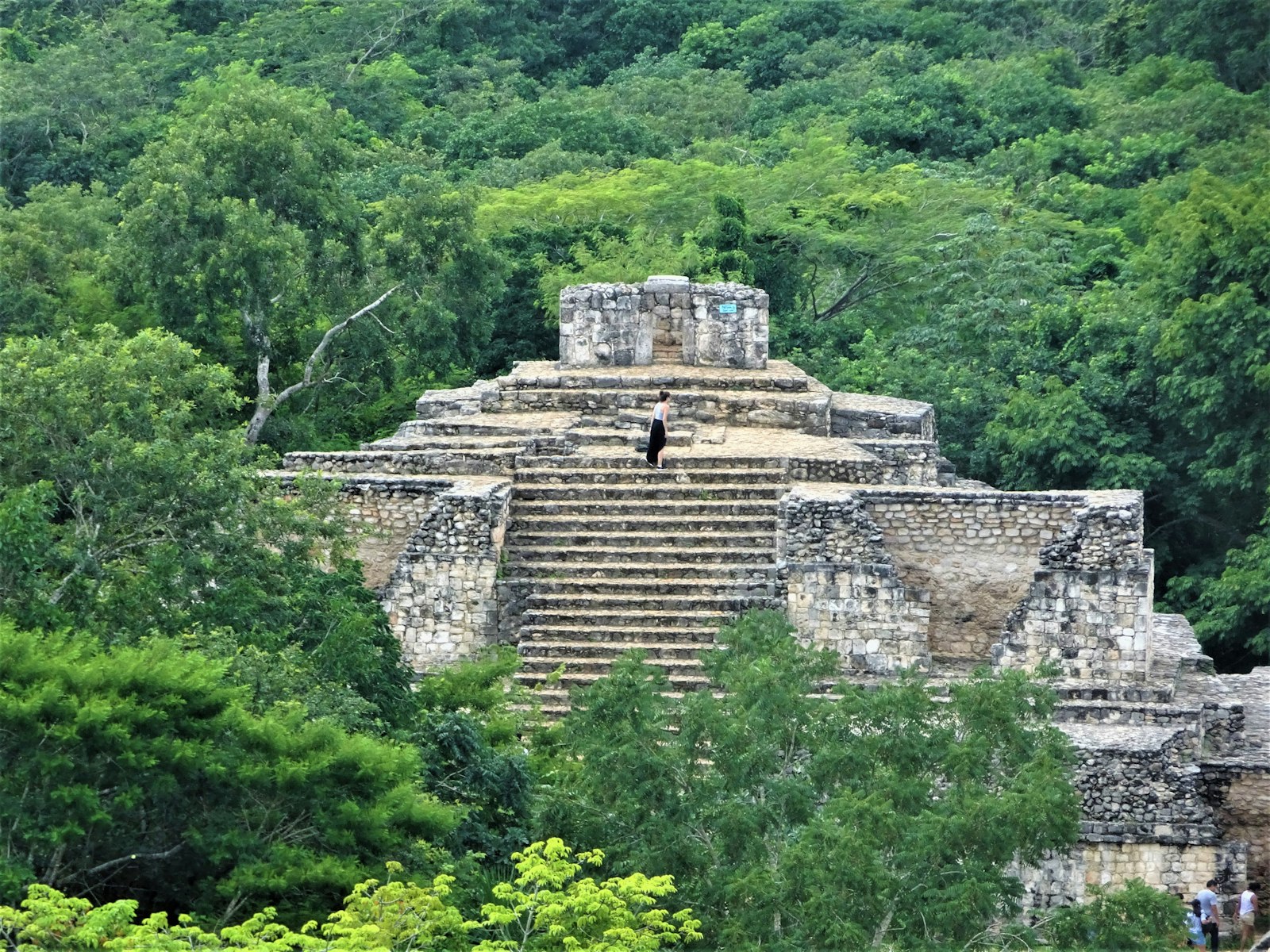
Ruins today are grey because centuries of weather stripped their paint. They weren't built that way. The Templo Mayor in Mexico City still preserves traces of its original color, and murals survive at sites like Teotihuacan.

The Maya murals of Bonampak in Chiapas, painted around 790 CE, are one of the most striking examples. They're full of rich color: courtiers in elaborate costume, musicians, a battle and the presentation of captives. They're also a reminder that these cities were lived-in places, with color, textiles and ceremony everywhere.

The same goes for urban planning. Research at Copan by archaeologist Karla Davis-Salazar has documented Late Classic drainage and water management systems. These weren't jungle villages. They were planned cities with engineering to match.

Stereotype 3: warriors in animal skins

This one is especially common. Jaguar warriors get drawn wearing a literal jaguar pelt.

The colonial sources tell a different story. The Codex Mendoza (made around 1541), which records the tribute paid to Tenochtitlan, lists warrior suits called tlahuiztli among the tribute. They were full-body garments of cloth covered in feathers, and the jaguar pattern was typically made with feather mosaic. The same codex shows matching feathered shields. Featherwork was one of the most prized arts in the Mexica world, and rank was shown through these suits.

Other sources add variety: the Lienzo de Tlaxcala, painted in the mid-sixteenth century by the Tlaxcalans (enemies of the Mexica who allied with the Spanish), shows its own warriors and their gear. Different peoples dressed differently.

Stereotype 4: anonymous, faceless people

Media often shows Mesoamericans as crowds: warriors, priests, victims. Almost never as named individuals with histories.

The sources are full of named people. Yaxchilan Lintel 24, a carved limestone panel now in the British Museum, shows the ruler Itzamnaaj Bahlam III (often called Shield Jaguar) holding a torch over his wife, Lady K'abal Xook, as she performs a bloodletting ritual. The hieroglyphic text dates it to 709 CE and names both of them with their titles. Maya writing is a full writing system, and it recorded dynasties, dates and events.

In central Mexico, Nezahualcoyotl (1402 to 1472), ruler of Texcoco, is remembered as a poet and builder as much as a warrior, and appears in full regalia in the Codex Ixtlilxochitl. The Mexica rulers Ahuizotl and Moctezuma II appear in the Codex Tovar with their name glyphs. Women appear too: Fray Bernardino de Sahagún's research with Nahua collaborators, especially the Florentine Codex, documents women's dress, work and roles in detail.

Stereotype 5: violence as the whole story

Warfare and human sacrifice were real parts of Mesoamerican life, and hiding them would be its own distortion. Bonampak shows battle and captives, and Lintel 24 shows ritual bloodletting. The Bonampak murals, found in the 1940s, actually helped overturn an older scholarly idea that the Classic Maya were peaceful stargazers.

The problem is when violence is the only story. The same sources describe markets, gardens, poetry, astronomy, law and art. When Bernal Díaz del Castillo, a Spanish soldier in Cortés's expedition, wrote about first seeing Tenochtitlan, he compared it to the enchanted cities of chivalric romances. He wrote that soldiers who had been to Rome and Constantinople said they had never seen a market so large and well ordered as Tlatelolco's. That's a conqueror writing, with every reason to make the enemy look barbaric, and still he couldn't hide his astonishment.

Stereotype 6: cultures that ended

Maybe the most harmful stereotype is that these are "lost civilizations." They aren't lost. Millions of people speak Mayan languages today, and Nahuatl, the language of the Mexica, has well over a million speakers in Mexico. Zapotec, Mixtec and many other peoples continue living cultures with their own art, textiles and design traditions.

When we draw these cultures only as ancient ruins, we erase the people who are still here.

What designers and illustrators can do

None of this means you can't make a stylized, fantastical or fun piece inspired by Mesoamerica. It means making choices on purpose instead of copying the cliché. A few habits help:

  1. Name the culture and the period. "Aztec" and "Maya" aren't interchangeable, and 700 CE isn't 1500 CE. Decide which one you're depicting before you sketch.
  2. Go to primary sources. Codices like the Codex Mendoza, the Florentine Codex and the Codex Tovar are available in high-resolution digital facsimiles. Museum collections (the British Museum, the Met, Mexico's National Museum of Anthropology) publish photographs of real objects.
  3. Use archaeology for places. Site maps, reconstructions and excavation reports tell you how cities were laid out and what buildings looked like when painted.
  4. Read the sources critically. Many "primary sources" were made after the conquest, sometimes by or for Spaniards. They're invaluable, but they have points of view. Cross-check when you can.
  5. Credit and consult. If you use a specific reconstruction, photograph or scholar's work, credit it. If your project represents living communities, talk to people from those communities.
  6. Show everyday life. Markets, families, craftspeople and scholars are underrepresented and far more interesting than yet another sacrifice scene.

A good test: before you finish an illustration, ask yourself which source each major element came from. If the answer for most of them is "other movies" or "a video game," you know where to start looking.

Design history

August 3, 2026

·

5 min read

Beyond Grey Pyramids: How Media Stereotypes Mesoamerica, and What Designers Can Do Instead

Common media clichés about Aztec, Maya and other Mesoamerican cultures, what the sources actually show, and how illustrators can do better.

Search for "Aztec warrior" and you'll probably get the same picture again and again: a muscular man in a real jaguar skin, standing in front of a grey stone pyramid, somewhere in a jungle, possibly next to a sacrifice. It's dramatic. It's also mostly wrong, or at least wildly incomplete.

A while ago I came across a two-panel educational poster that circulated online, comparing popular media depictions of Mesoamerican cultures with primary sources: codices, colonial chronicles, archaeological maps, site photographs. It's a great example of something designers and illustrators don't do often enough: going back to the sources before drawing a culture.

So here are the most common stereotypes, what the evidence shows, and what we can do about it.

Stereotype 1: "Mesoamerica" is one culture

Films, games and merchandise regularly blend Aztec, Maya and even Inca imagery (the Inca aren't Mesoamerican at all; they're Andean) into one generic "ancient American" look.

In reality, Mesoamerica covers thousands of years and many distinct peoples. A few examples of how far apart they are:

  • Teotihuacan, the city of the huge Pyramids of the Sun and Moon near today's Mexico City, flourished roughly between 100 BCE and 550 CE. It isn't Aztec. It was already in ruins when the Mexica (the people we usually call Aztecs) founded Tenochtitlan in the 1300s.
  • The Mexica deeply admired it, though. They gave it the Nahuatl name we still use, and archaeologists have found Teotihuacan objects buried as offerings in Tenochtitlan's Templo Mayor. Some Mexica art and architecture consciously borrowed Teotihuacan forms. The relationship is closer to how Renaissance Europe looked back at Rome than to "same people."
  • The Classic Maya cities of the south, like Copan in Honduras or Yaxchilan in Chiapas, peaked between roughly 250 and 900 CE, hundreds of years before the Mexica rose to power.

When a single scene mixes a Teotihuacan pyramid, Maya glyphs and an Aztec emperor, it's like drawing a Roman legionary guarding a Gothic cathedral next to a Victorian train station.

Stereotype 2: bare grey stone

Ruins today are grey because centuries of weather stripped their paint. They weren't built that way. The Templo Mayor in Mexico City still preserves traces of its original color, and murals survive at sites like Teotihuacan.

The Maya murals of Bonampak in Chiapas, painted around 790 CE, are one of the most striking examples. They're full of rich color: courtiers in elaborate costume, musicians, a battle and the presentation of captives. They're also a reminder that these cities were lived-in places, with color, textiles and ceremony everywhere.

The same goes for urban planning. Research at Copan by archaeologist Karla Davis-Salazar has documented Late Classic drainage and water management systems. These weren't jungle villages. They were planned cities with engineering to match.

Stereotype 3: warriors in animal skins

This one is especially common. Jaguar warriors get drawn wearing a literal jaguar pelt.

The colonial sources tell a different story. The Codex Mendoza (made around 1541), which records the tribute paid to Tenochtitlan, lists warrior suits called tlahuiztli among the tribute. They were full-body garments of cloth covered in feathers, and the jaguar pattern was typically made with feather mosaic. The same codex shows matching feathered shields. Featherwork was one of the most prized arts in the Mexica world, and rank was shown through these suits.

Other sources add variety: the Lienzo de Tlaxcala, painted in the mid-sixteenth century by the Tlaxcalans (enemies of the Mexica who allied with the Spanish), shows its own warriors and their gear. Different peoples dressed differently.

Stereotype 4: anonymous, faceless people

Media often shows Mesoamericans as crowds: warriors, priests, victims. Almost never as named individuals with histories.

The sources are full of named people. Yaxchilan Lintel 24, a carved limestone panel now in the British Museum, shows the ruler Itzamnaaj Bahlam III (often called Shield Jaguar) holding a torch over his wife, Lady K'abal Xook, as she performs a bloodletting ritual. The hieroglyphic text dates it to 709 CE and names both of them with their titles. Maya writing is a full writing system, and it recorded dynasties, dates and events.

In central Mexico, Nezahualcoyotl (1402 to 1472), ruler of Texcoco, is remembered as a poet and builder as much as a warrior, and appears in full regalia in the Codex Ixtlilxochitl. The Mexica rulers Ahuizotl and Moctezuma II appear in the Codex Tovar with their name glyphs. Women appear too: Fray Bernardino de Sahagún's research with Nahua collaborators, especially the Florentine Codex, documents women's dress, work and roles in detail.

Stereotype 5: violence as the whole story

Warfare and human sacrifice were real parts of Mesoamerican life, and hiding them would be its own distortion. Bonampak shows battle and captives, and Lintel 24 shows ritual bloodletting. The Bonampak murals, found in the 1940s, actually helped overturn an older scholarly idea that the Classic Maya were peaceful stargazers.

The problem is when violence is the only story. The same sources describe markets, gardens, poetry, astronomy, law and art. When Bernal Díaz del Castillo, a Spanish soldier in Cortés's expedition, wrote about first seeing Tenochtitlan, he compared it to the enchanted cities of chivalric romances. He wrote that soldiers who had been to Rome and Constantinople said they had never seen a market so large and well ordered as Tlatelolco's. That's a conqueror writing, with every reason to make the enemy look barbaric, and still he couldn't hide his astonishment.

Stereotype 6: cultures that ended

Maybe the most harmful stereotype is that these are "lost civilizations." They aren't lost. Millions of people speak Mayan languages today, and Nahuatl, the language of the Mexica, has well over a million speakers in Mexico. Zapotec, Mixtec and many other peoples continue living cultures with their own art, textiles and design traditions.

When we draw these cultures only as ancient ruins, we erase the people who are still here.

What designers and illustrators can do

None of this means you can't make a stylized, fantastical or fun piece inspired by Mesoamerica. It means making choices on purpose instead of copying the cliché. A few habits help:

  1. Name the culture and the period. "Aztec" and "Maya" aren't interchangeable, and 700 CE isn't 1500 CE. Decide which one you're depicting before you sketch.
  2. Go to primary sources. Codices like the Codex Mendoza, the Florentine Codex and the Codex Tovar are available in high-resolution digital facsimiles. Museum collections (the British Museum, the Met, Mexico's National Museum of Anthropology) publish photographs of real objects.
  3. Use archaeology for places. Site maps, reconstructions and excavation reports tell you how cities were laid out and what buildings looked like when painted.
  4. Read the sources critically. Many "primary sources" were made after the conquest, sometimes by or for Spaniards. They're invaluable, but they have points of view. Cross-check when you can.
  5. Credit and consult. If you use a specific reconstruction, photograph or scholar's work, credit it. If your project represents living communities, talk to people from those communities.
  6. Show everyday life. Markets, families, craftspeople and scholars are underrepresented and far more interesting than yet another sacrifice scene.

A good test: before you finish an illustration, ask yourself which source each major element came from. If the answer for most of them is "other movies" or "a video game," you know where to start looking.