
Most design history courses start around 1900, with posters, the Bauhaus and the grid. That's fair, since it's where our profession got its name. But logos, layouts and persuasive images didn't appear out of nowhere. Long before anyone called themselves a designer, people were deciding what an image was for, who got to make it, and what counted as beautiful.
A useful way to make sense of all that is to split Western cultural history into three big eras: premodern, modern and postmodern. The split is a simplification (historians argue about every boundary), but it works because each era answers one question differently: where does truth come from?
- In the premodern era, truth comes from God, tradition and ancient authority.
- In the modern era, truth is something humans can discover through reason and science.
- In the postmodern era, people start doubting there's a single truth at all.
This first part covers the longest stretch, from the earliest images to the late 1800s. One caveat before we start: this is the story of the Western tradition (Europe and the cultures it grew from), because that's the one most design education is built on. It's not the only one, and that limitation is part of the story too.
Ancient civilizations: images with a job
The oldest images we know of, cave paintings, fertility figures and early religious art, weren't "decoration" in our sense. They had a function: to honor a god, record a hunt, protect a household, mark who was in charge.
Egyptian art is a good example of images working as a system. Figures follow strict conventions: head and legs in profile, shoulders facing front, and the most important person drawn largest. That last rule, called hierarchical scale, is a layout decision. Size tells you who matters before you read a single hieroglyph. Designers still do exactly this with headline sizes.
On Crete, the Bronze Age Minoan culture painted lively frescoes of animals, plants and people at palaces like Knossos. Minoan culture came before classical Greece and helped shape it.
Greece and Rome: the foundation stones
Ancient Greece and Rome are the pillars most of Western culture leans on. Ideas like democracy, ethics and the search for ideal proportions come from here, along with a habit of thinking that beauty can be measured.
Rome also left designers a direct inheritance: its capital letters. The inscription carved at the base of Trajan's Column (113 CE) is still studied as a model of letterform proportion, and it's the basis of the Trajan typeface you've seen on countless movie posters.
The Middle Ages: art as a path to God
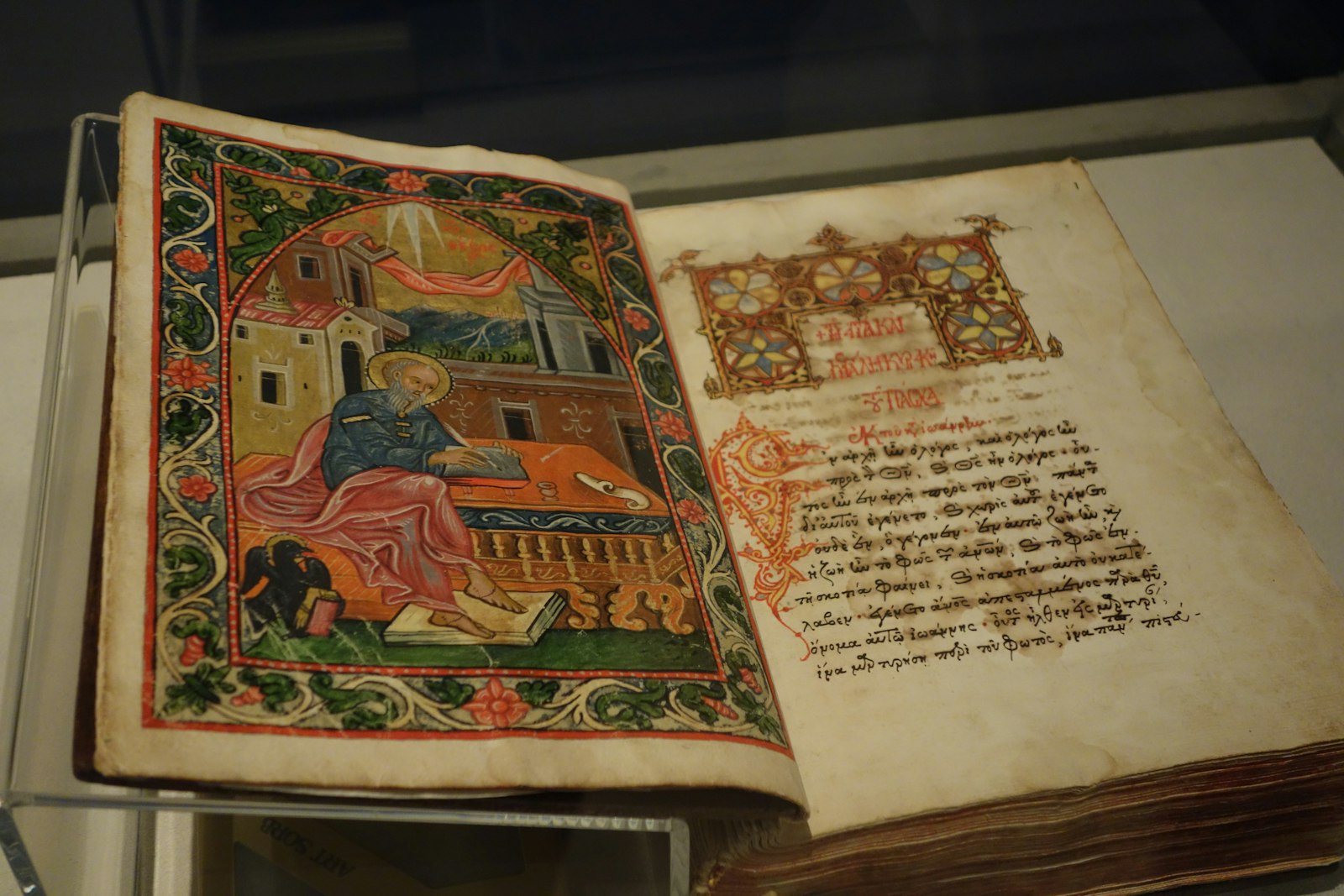
After the Western Roman Empire fell in the fifth century, the Church became the main patron of images in Europe. Mosaics, frescoes and illuminated manuscripts existed to represent, worship and teach the divine. Most people couldn't read, so images carried the stories.
Illuminated manuscripts are worth a close look if you do editorial work. Pages like those in the Book of Kells (around 800 CE) combine text, ornament and image in dense, carefully planned layouts, with oversized decorated initials marking where to start reading. The drop cap you use in a long-form article has medieval roots.
Philosophers of the period, most famously Thomas Aquinas in the thirteenth century, worked to reconcile Aristotle's philosophy with Christian faith. Reason was welcome, as long as it served belief.
Gothic: designing with light
Gothic architecture (roughly 1100 to 1400) is where that theology became a building brief. Around 1137, Abbot Suger began rebuilding the abbey church of Saint-Denis near Paris around the idea of lux nova, "new light": divine light pouring through colored glass would lift the soul toward God. That idea pushed architects toward taller walls, pointed arches and huge stained-glass windows. A spiritual goal drove a technical innovation, which is a pattern you'll see again and again in design.
The Renaissance: humans move to the center
The Renaissance (roughly 1300 to 1600, starting in Italy) introduced humanism: the idea that human beings, not only God, could shape history and create beauty on their own. Artists studied anatomy, looked back to Greek and Roman models, and developed linear perspective, a mathematical system for making a flat surface look deep.
Perspective matters to designers because it's a convention we now treat as "natural." It isn't. It was invented, taught and argued over, which is a good reminder that plenty of what feels obvious in visual communication was once somebody's new idea.
Printing and the Scientific Revolution
Around 1450, Johannes Gutenberg's movable-type press made it possible to reproduce text quickly and cheaply. Ideas could now travel faster than any church or king could control them. That spread of printed knowledge helped fuel the Scientific Revolution, the work of Copernicus, Galileo, Kepler and eventually Isaac Newton, which changed how Europeans understood astronomy, the body, physics and the method of finding things out. At the same time, the Age of Discovery was pushing European ships (and European empires) across the world.
Baroque: art as persuasion
When Martin Luther's protest in 1517 launched the Protestant Reformation, the Catholic Church answered with the Counter-Reformation. Art was one of its main tools. Baroque art and architecture (roughly 1600 to 1730, centered in Rome) were meant to impress: dramatic compositions, rich ornament, buildings designed as propaganda for the stability and authority of Church and crown.
In painting, the signature technique was chiaroscuro, strong contrast between light and dark. Caravaggio's paintings throw a spotlight on the key figure and let everything else fall into shadow. If you've ever used contrast to guide someone's eye to a call to action, you're using a Baroque trick.
Rococo and the Enlightenment
After Louis XIV died in 1715, French aristocrats who were tired of his heavy, formal style embraced Rococo (roughly 1720 to 1780): lighter, playful, full of curves and natural motifs, meant to delight and surprise. Jean-Honoré Fragonard's The Swing (1767) is Rococo in one image, all pastel frills and flirtation.
Here's the funny part: Rococo happened at the same time as the Enlightenment. While aristocrats decorated salons, philosophers argued that reason, not faith, was the path to knowledge. Neoclassicism (roughly 1750 to 1830) gave that mood a look: clean lines and Greek and Roman references, as in Jacques-Louis David's Oath of the Horatii (1784). Enlightenment ideas helped spark the French Revolution in 1789. (The Bavarian Illuminati, founded in 1776, also date from this period. They were a real secret society, banned within a decade, and they've inspired far more conspiracy theories than they ever earned.)
Romanticism and the first photograph
Romanticism (roughly 1780 to 1850) pushed back against all that reason. It celebrated individual feeling, imagination, heroism, the exotic and the mysterious, and it was suspicious of industrial capitalism. The artist became a lone genius, and Beethoven became the model of that figure. Caspar David Friedrich's Wanderer above the Sea of Fog (around 1818) is the image most people think of when they hear the word.
Around 1826 to 1827, the French inventor Nicéphore Niépce made View from the Window at Le Gras, the oldest surviving camera photograph. The exposure took hours at least (estimates run from about eight hours to several days), which is why sunlight seems to hit the buildings from both sides. Image-making would never be the same.
Realism: showing ordinary life
Realism (roughly 1830s to 1870s, mainly in France) rejected idealized subjects. Painters like Gustave Courbet showed working people, poverty and injustice with a documentary eye, as in The Stone Breakers (1849). It's an early version of a question designers still face: whose life gets shown, and how honestly?
The crack in the old world
In The Gay Science (1882), Friedrich Nietzsche wrote his famous line, "God is dead." He wasn't celebrating. He was describing a culture that had stopped building its values on religion without knowing what to put in its place. That uncertainty is the doorway to modernism.
The bridge to modern design
A few late-nineteenth-century movements sit right on that doorway:
- Arts & Crafts (Britain, roughly 1860 to 1920) idealized medieval craft and handmade objects. William Morris wanted to bring beautiful things to ordinary people in the age of the factory, but handmade goods turned out to be expensive, and the movement argued with itself about how much to accept machines.
- Impressionism (France, exhibiting as a group from 1874 to 1886) painted outdoors, fast, trying to capture light and perception rather than logical clarity. It's often called the first modern movement.
- Post-Impressionism (roughly 1886 to 1905), with Cézanne, Van Gogh and Gauguin, pushed even further into the artist's personal, symbolic view of the world.
- Art Nouveau (roughly 1890 to 1914) took nature's curves and built them in iron and glass, the new materials of the industrial age. Alphonse Mucha's posters and Hector Guimard's Paris Métro entrances (1900) made art part of the street.
Notice what's happening: art is slowly stepping away from serving God or king, and moving toward serving the individual, the market and the city. That's the world design as a profession is about to be born into.
Try this
Pick one object in your room with ornament on it, a mug, a book cover, a phone case. Ask who that ornament is for and what it's trying to say about its owner. Premodern ornament almost always had an answer: status, faith, belonging. Does yours?
Next: Design History in Three Cultural Eras, Part 2: Modernism and the Birth of Postmodern Thought follows what happened when artists decided reason and progress could remake the world, and then watched two world wars test that belief. Part 3: Postmodern Graphic Design and the Digital Age brings the story to your screen.